
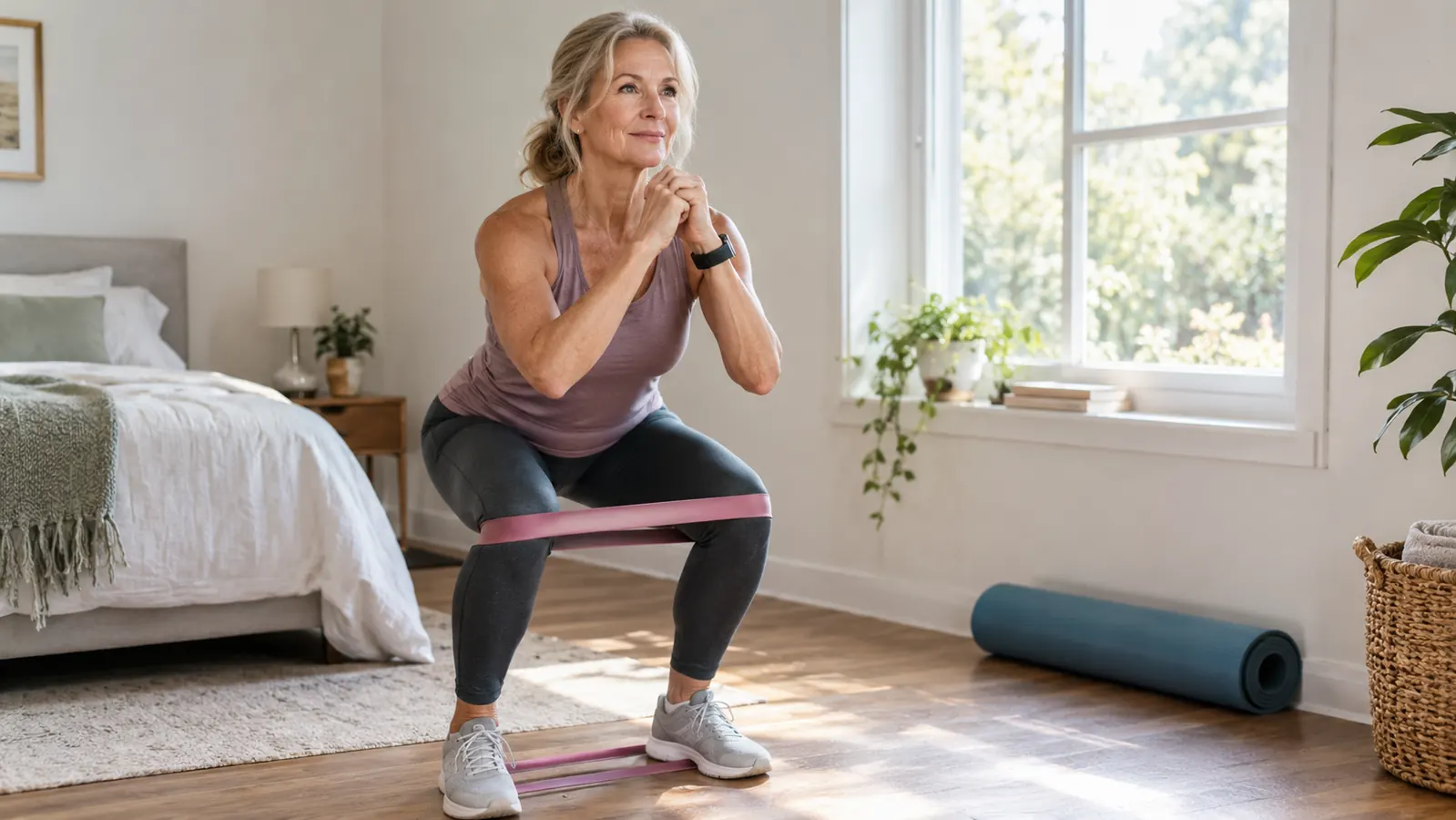
About two years ago, I started dreading the stairs in our split level in Springfield. I am Linda, 57, a retired middle-school librarian, and at 55 my knees began to complain every time I carried the laundry up from the basement. My neighbor and I walk most mornings, and that helped, but I knew walking alone was not going to rebuild the strength I had let slide over years of sitting at a circulation desk. I wanted something I could do in the spare bedroom, without a gym membership and without a pile of equipment I would trip over by Tuesday.
I priced dumbbells and kettle bells, looked at the space they would take up, and almost talked myself out of the whole idea. Then a friend mentioned resistance bands, and I ordered a set of Fit Simplify Resistance Loop Exercise Bands, which came with an instruction guide and a carry bag. I have used them almost daily for a year now, and this is the exact routine I built, step by step, so you can do the same without overthinking it. If you have been telling yourself you need to get stronger but you keep putting it off because the gym feels like a production, this plan is for you.
I am not a fitness person. I spent thirty years behind a library desk, and my idea of a workout was shelving a heavy cart of books. That is exactly why the bands worked for me. They came in a small carry bag I could stash in a drawer, they cost a fraction of a gym membership, and they were forgiving when I got the form wrong. There is no learning curve like there is with free weights, and no machine to adjust. I could be in and out of that corner in fifteen minutes, which is about the only length of workout I would have actually kept up.
Start with a band set that includes the guide
Fit Simplify loop bands come with an instruction guide and a carry bag, so you can start tonight without hunting for a tutorial. Check today's price on Amazon and have the set at your door before the weekend, then give yourself ten minutes in a corner of a room.
Amazon Check Today's Price on Amazon →Step 1: Clear a corner and set a tiny starting goal
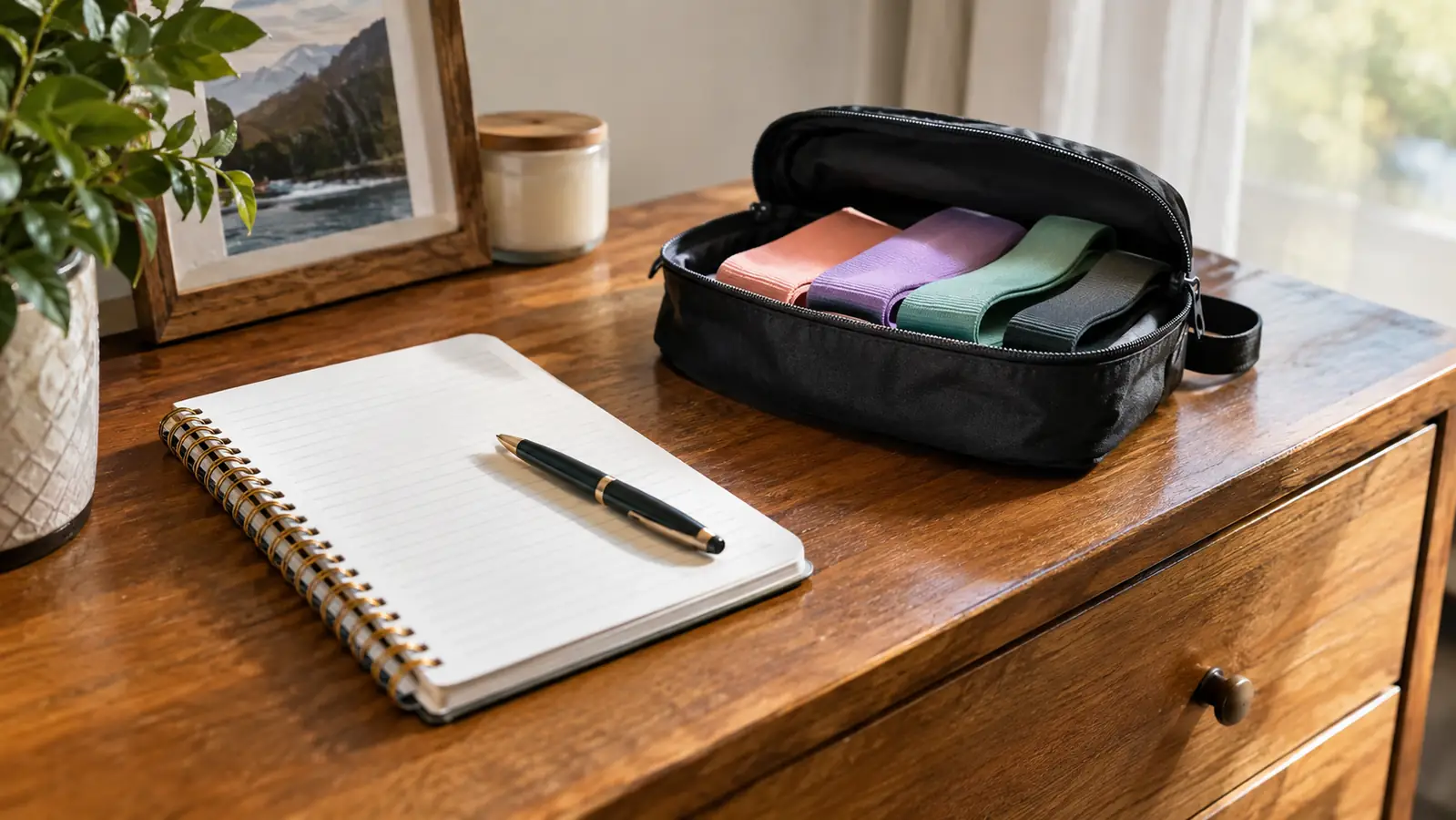
You do not need a home gym. I cleared one corner of the spare bedroom, about the size of a welcome mat, and that was enough. I put my spiral notebook and a water bottle on the dresser, laid down a yoga mat to mark the spot, and set a rule for myself: ten to fifteen minutes, three mornings a week, no more. That low bar is what carried me through the first month, because it never felt like a big deal to keep, and the mat on the floor reminded me every morning why I was there. The point of the first week is to make the routine so small it is hard to say no to.
I wrote the goal in my notebook: show up three times a week and do ten minutes. Not a scale number, not a pants size, just showing up. When you are past 50, consistency beats intensity every time, and a tiny goal is one you can actually keep on a week when work or family leaves you tired. A short session that happens beats a perfect session that does not.
If you have any health conditions or take medication, run the plan past your doctor or pharmacist first. That is not a formality. I checked with my doctor before I started, and I am glad I did, because she told me to take it slow on anything that loaded my knees and to stop if anything hurt more than a gentle stretch. I also started with the lightest band in the set, which turned out to be smart advice for week one.
Step 2: Learn the band basics and warm up properly
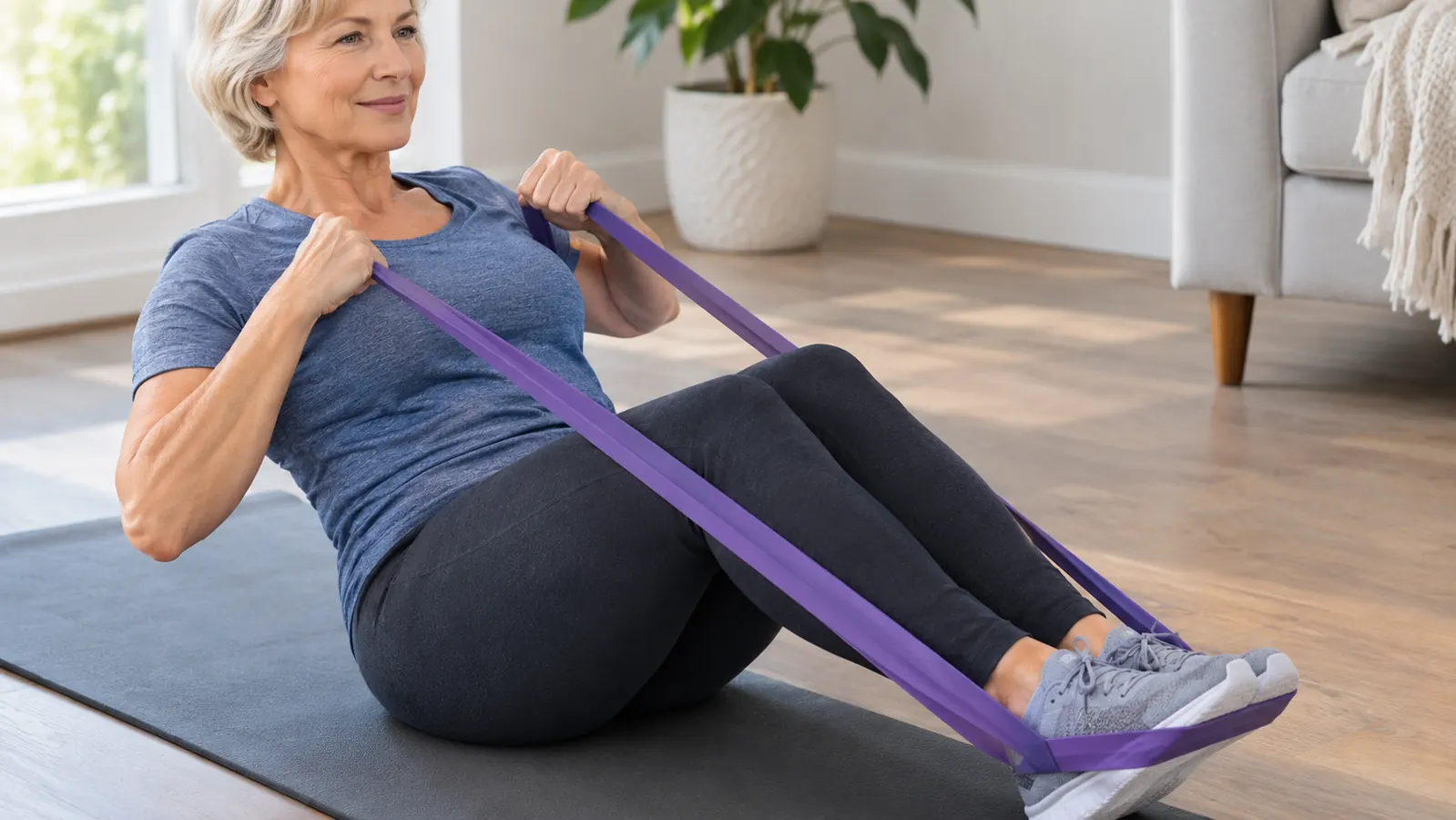
The Fit Simplify set comes with an instruction guide that shows the basic movements, and I read it before my first session instead of improvising. The bands are loops, and you use them by stepping on them, holding them with both hands, or looping them around a fixed point like a door anchor or a sturdy leg. That first week I only practiced the holds and the standing moves, with no plan to break a sweat. Learning the moves without the strain meant my form was decent by the time I added any real resistance.
I started every session with five minutes of easy movement: marching in place, arm circles, and gentle leg swings. Warming up matters more as you get older. Cold muscles and tendons are how people pull something in week one, and a pulled muscle is how people quit before they ever see progress. Five minutes of marching felt silly at first, and it saved me from a whole category of aches.
I also learned to read my own body. If a movement hurt, I stopped and checked the guide. If it just felt challenging, I kept going. That one distinction saved me a lot of grief and a few mornings of stiffness, and it is the difference between a routine you keep and a routine that keeps you on the couch. I made one beginner mistake: I grabbed a heavier band too early and could barely finish a set. The next session I switched lighter, and the moves finally felt smooth. Start lighter than you think you need.
Step 3: Build a lower body circuit you can do in ten minutes
I built my first circuit from three moves: band squats, glute bridges, and lateral band walks. For band squats I stood on the band with my feet shoulder width apart, held the band up at my shoulders, and squatted down and pushed back up. Ten reps felt honest, not heroic, and that is exactly where you want to start. I chose these three because they cover the muscles that walking misses, especially the hips and the backs of the legs.
Glute bridges I did on a yoga mat with the band looped just above my knees. Lying on my back with my feet flat on the floor, I pushed my hips up and squeezed at the top before lowering slowly. Lateral band walks were the hardest for me, because they work the outer hip muscles that plain walking never touches. I did ten small steps one way and ten back, and my hips let me know about it the next day.
I repeated the circuit twice, and the whole thing took about ten minutes. The first few weeks I noticed my knees felt steadier on the stairs, and that small payoff was the encouragement I needed to keep going. On busy days I did just the squats and bridges and skipped the walks, and a shortened workout still counted. Slow progress is still progress, and I wrote down how each session felt in my notebook so I could look back and see the arc.
Step 4: Add upper body work without buying anything else
Once the lower body circuit felt routine, I added three upper body moves with the same bands: rows, chest presses, and shoulder presses. For rows I looped the band around the leg of our solid oak dresser, held an end in each hand, and pulled toward my ribs. It is the closest thing I have found to a gym cable machine, without the gym. The dresser worked, but a sturdy table leg or a closed door works just as well if you do not have a piece of furniture you trust.
For chest presses I anchored the band behind my back at shoulder height and pushed forward against the resistance. For shoulder presses I stepped on the band and pressed both hands up overhead. Twelve reps of each, two rounds, and my arms felt it the next day in a good way. I did not love these moves at first, and my early rows pulled on my neck until I fixed my form with the guide, but after a few sessions they became my favorite part of the routine.
Dale watched me one morning and said the bands looked too easy to do anything. I handed them to him, and he could not finish my set of rows. He stopped teasing after that. The resistance is real, and because the bands stretch, you control the load yourself, which is gentler on aging joints than dropping a heavy dumbbell.
Step 5: Track your progress and add a little each month
This is the step that kept me going when motivation dipped. Every session I wrote the date, the moves, and the reps in my spiral notebook. Once a month I added one rep to each move, or one extra round, or I held the squat for two seconds longer. Tiny increases, applied consistently, beat big plans that I would abandon by the second week of February. The notebook turned exercise from a vague promise into something I could see adding up, week after week.
I also wrote down how I felt, because energy levels are honest even when my memory is not. Some weeks I had plenty of energy and added a round. Some weeks I was tired and did the minimum, and I learned that doing the minimum still counts. When I saw three good weeks in a row, I added a fourth session. When I was sore or run down, I backed off and walked an extra lap instead.
The bands make that flexibility easy, because there is no heavy weight to drop. I can step out of the loop in a second if I need to. After about six months, my clothes fit differently and the stairs stopped being something I dreaded. I did not lose weight overnight, and I have not turned into an athlete. I am a retired librarian who does fifteen minutes of band work in a spare bedroom, and that is enough to feel stronger, which is the whole point.
What Else Helps
The bands are one piece of the puzzle, and I would be dishonest if I said they did the work alone. I pair them with my morning walks with my neighbor, I cook more meals at home and eat smaller portions, and I go to bed at a reasonable hour instead of snacking in front of the television.
I read a chapter of a novel most nights instead of eating out of boredom, and that one habit changed my evenings more than any exercise. If you are making changes for your health, do it all together: move a little, eat a little better, sleep well, and check with your doctor before you start anything new, especially if you take medication. No single tool does the job, but a routine you can keep is the one that works.
If you are just starting out, give yourself twelve weeks before you judge the results. I did not notice much at four weeks, and I almost stopped. At twelve weeks the difference was obvious enough that Dale noticed without me saying anything. Bodies change slowly, and the routine that survives is the one you can live with. For me that meant a few simple moves, a notebook, and a yoga mat in a corner of the spare bedroom, nothing fancier than that.
After six months the stairs stopped being something I dreaded, and I never once missed the gym.
Your first session can be tonight
A set of Fit Simplify loop bands with a guide and carry bag is all you need to start. Check today's price on Amazon, clear a corner of a room, lay down a mat, and give yourself ten minutes tonight.
Amazon Check Today's Price on Amazon →