
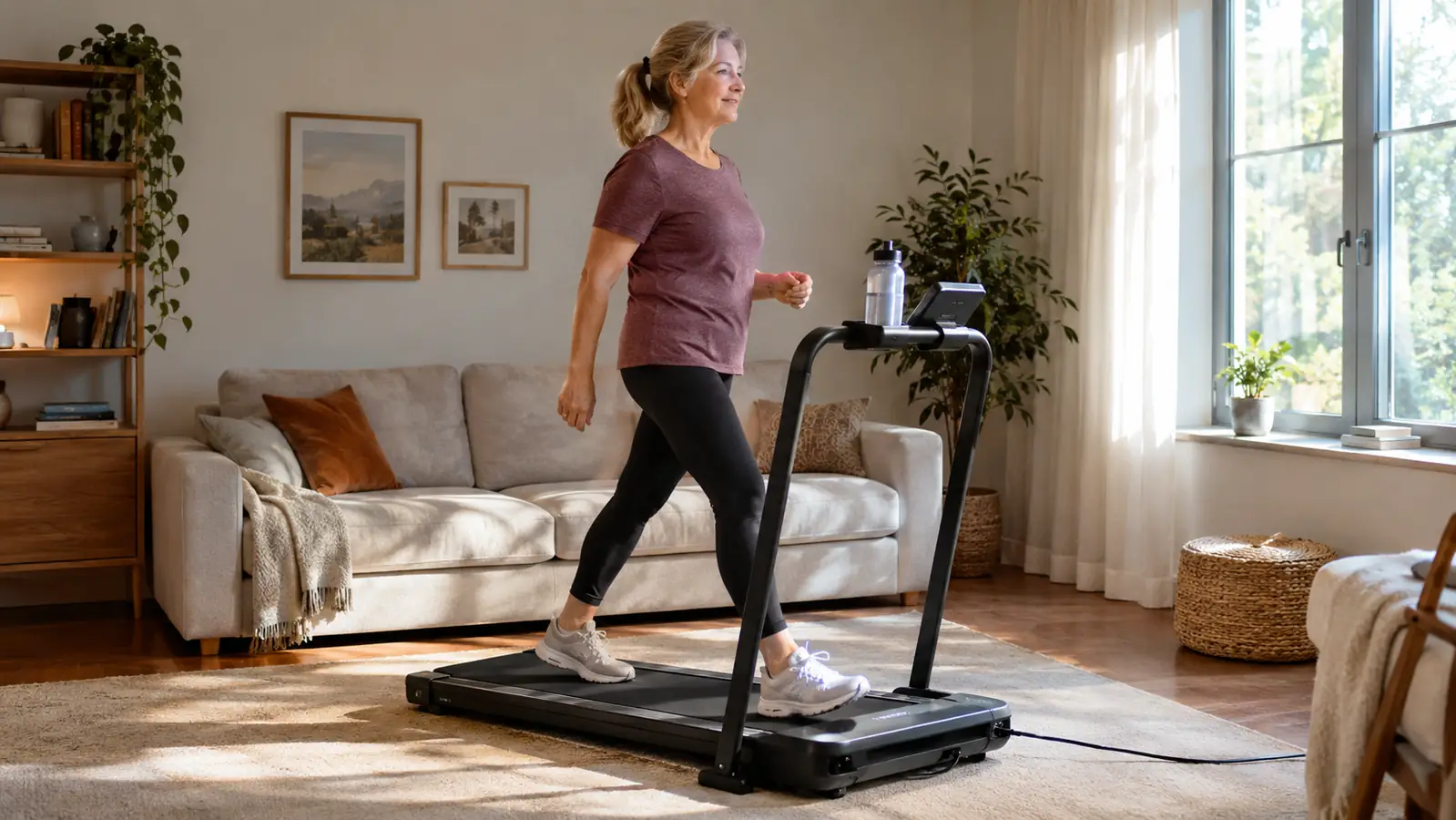
I did not set out to buy a walking pad. I set out to stop feeling guilty every evening when my step count came in at 4,000. I am Linda, 57, a retired middle-school librarian in Springfield, Missouri, and I have spent two years building a walking habit that mostly worked, until winter and a bad knee made it fall apart. My neighbor and I walk most mornings, but when the temperature dropped below freezing or the rain would not quit, I skipped it. Then I would sit at my desk grading old lesson plans I did not need, and my knees would ache from doing nothing. I tried marching in place during the news. I tried pacing the hallway. I tried a cheap stationary routine that left me bored by day three. What finally worked was a folding walking pad from Ulfario, and this is the exact step by step plan I used to reach 10,000 steps at home, most days, without ever putting on a coat.
I want to be clear about what this guide is and is not. It is not a promise that a machine will fix your health by itself. It is a routine: five small steps that build on each other, the same way I build my meals in my spiral notebook. The walking pad is the tool that made the routine possible for me, because it removed every excuse I had been using. No weather, no traffic, no needing to look presentable. If you are skeptical, good. I was skeptical too. I read the research summaries, I checked the return policy, and I started with a ten minute test walk while I waited for my tea to steep.
The walking pad that finally got me off the couch
The Ulfario Folding Walking Pad is the compact treadmill I used for this routine. It folds up against the wall when I am done, which matters in a house where the spare bedroom is already full of my husband Dale's things.
Amazon Check Today's Price on Amazon →Step 1: Set a baseline before you change anything
For three days, I did not try to hit any goal. I just wore my pedometer and wrote down what I actually did. The numbers were humbling. Monday: 4,112 steps. Tuesday: 3,876. Wednesday: 5,204 because I walked the long way to the grocery store. That baseline told me something important: I was not lazy, I was just missing about 6,000 steps a day, and most of them came from the hours between 2 p.m. and 8 p.m. when I was sitting at my desk or on the couch.
Do this before you buy anything or set any goal. You cannot fix a number you have not measured. I wrote mine in my spiral notebook, one page per day, with a column for steps and a column for how I felt. The feeling column turned out to be the useful part. On the days I hit 7,000 steps, I slept better. On the days I sat all afternoon, my knees complained on the stairs. That connection, written down in my own handwriting, is what kept me going when the novelty wore off.
If you do not have a pedometer, your phone probably counts steps already. I used the built in health app for the first week and it matched my pedometer closely enough. The point is not precision. The point is knowing where you are starting so you can see progress that is real, not imagined.
Step 2: Put the walking pad where you actually spend your afternoons
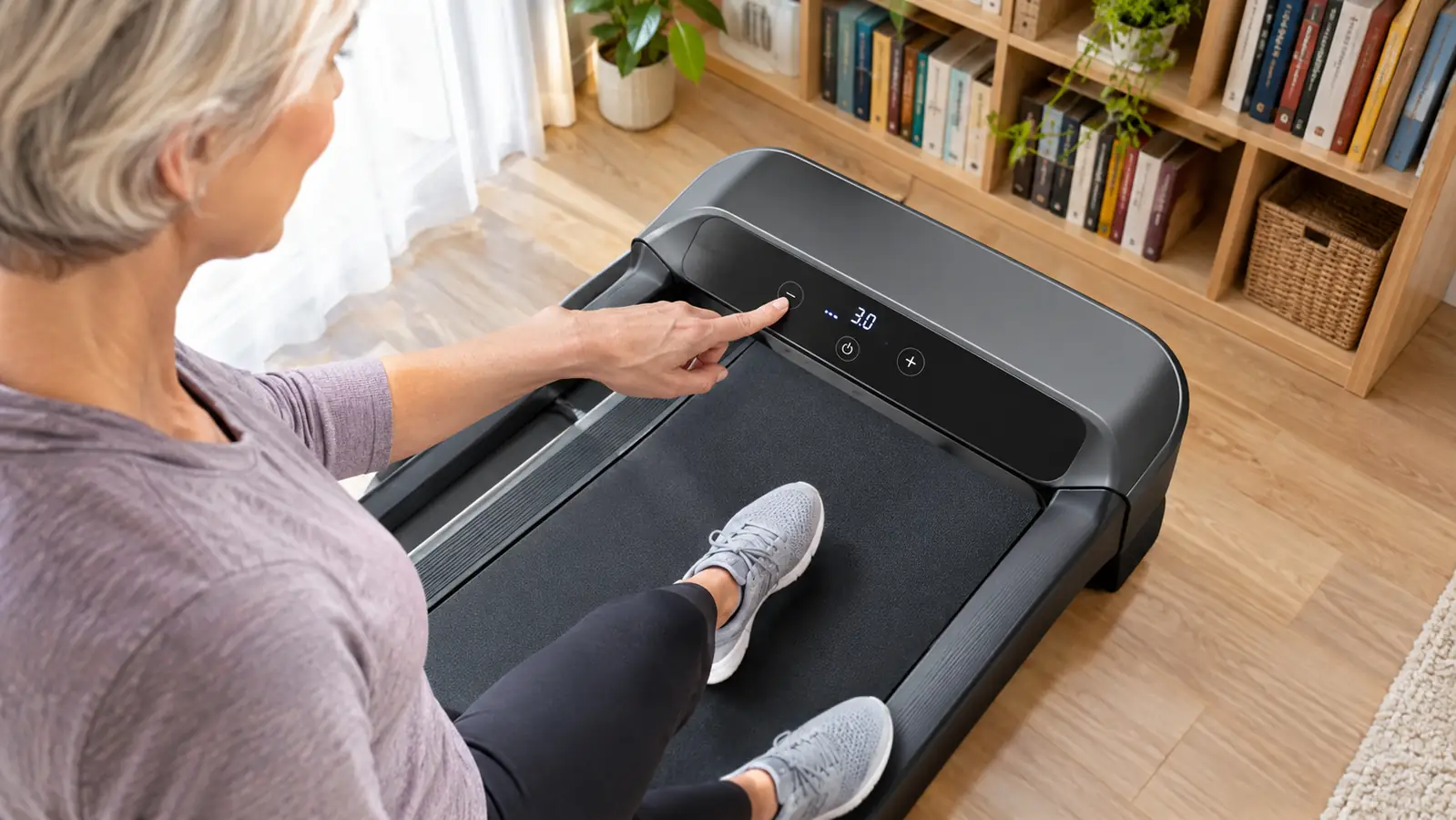
This is the step most people get wrong. They put the treadmill in the basement or the garage, and then they never use it because going to the basement feels like an errand. I put my Ulfario walking pad in the corner of the living room, right next to my reading chair and across from the television. It is not beautiful. It is practical. When I am watching the evening news, the pad is six feet away, already unfolded, and the only effort is standing up.
The Ulfario folds up when I am done, which was the feature that sold me. The whole thing leans against the wall behind the door, and the handle bar folds down flat. My husband Dale, who was skeptical about another gadget in the house, stopped complaining the first time he saw it tucked away. The walking surface is long enough for my normal stride, and the belt moves smoothly at a slow speed, which matters for someone whose knees are not what they were at 50.
Placement is a decision about your future self. If the pad is in the room where you already sit, you will use it. If it is in a room you have to walk to, you will find reasons not to. I tested this for two weeks. The first week, I kept it folded in the spare bedroom. I used it twice. The second week, I moved it to the living room. I used it every single day. Same machine, same me, different location, completely different result.
Step 3: Start with ten minutes and a specific trigger
I did not start with 10,000 steps. I started with ten minutes, right after lunch, every day. The trigger was simple: when I finished washing my lunch dishes, I stepped onto the pad. Not when I felt motivated. Not when I had energy. When the last plate was in the rack. That trigger mattered more than any goal, because it removed the decision. I did not have to negotiate with myself about whether I felt like walking. The dishes were done, so I walked.
The first few days, ten minutes felt long. I set the speed low, around 1.8 miles per hour, and I watched the news. By day five, ten minutes felt short, so I added five more. By the end of the second week, I was doing 25 minutes after lunch without thinking about it. That is about 2,500 steps, which does not sound like much, but it was 2,500 steps I was not getting before.
I also learned to stop checking the step count while I walked. The pad has a small display, and I found myself staring at it, waiting for the number to move. That made the time drag. Instead, I covered the display with a dish towel for the first week and just walked until my show ended. When I finally looked, I was always surprised. The habit matters more than the number, and the number follows the habit.
Step 4: Stack short walks into your existing day
Once the after lunch walk was solid, I added two more short sessions. The first was in the morning, while my coffee brewed. I set the pad to a slow speed and walked for eight minutes, just enough to wake up my legs. The second was in the evening, during the 6 o'clock news, for 15 minutes. That gave me three sessions a day: about 2,500 steps after lunch, 800 in the morning, and 1,500 in the evening. That is roughly 4,800 steps from the pad alone, before I counted anything else.
The rest came from ordinary life. I started parking farther from the store. I took the stairs instead of the elevator at the library, where I still volunteer twice a week. I walked to the mailbox instead of driving. I did not do anything heroic. I just stopped treating small movements as worthless. A trip to the mailbox is 200 steps. Three trips is 600. It adds up faster than you think.
On a typical day now, my notebook shows something like this: 800 steps before breakfast, 2,500 on the pad after lunch, 1,500 on the pad during the news, 1,200 from the grocery store, 900 from puttering around the house, and 1,500 from my morning walk with my neighbor. That is 8,400 before I even count the steps I take while cooking dinner. The pad is not the whole answer. It is the reliable middle of the day, the part that used to be empty.
Step 5: Track the trend, not the daily number
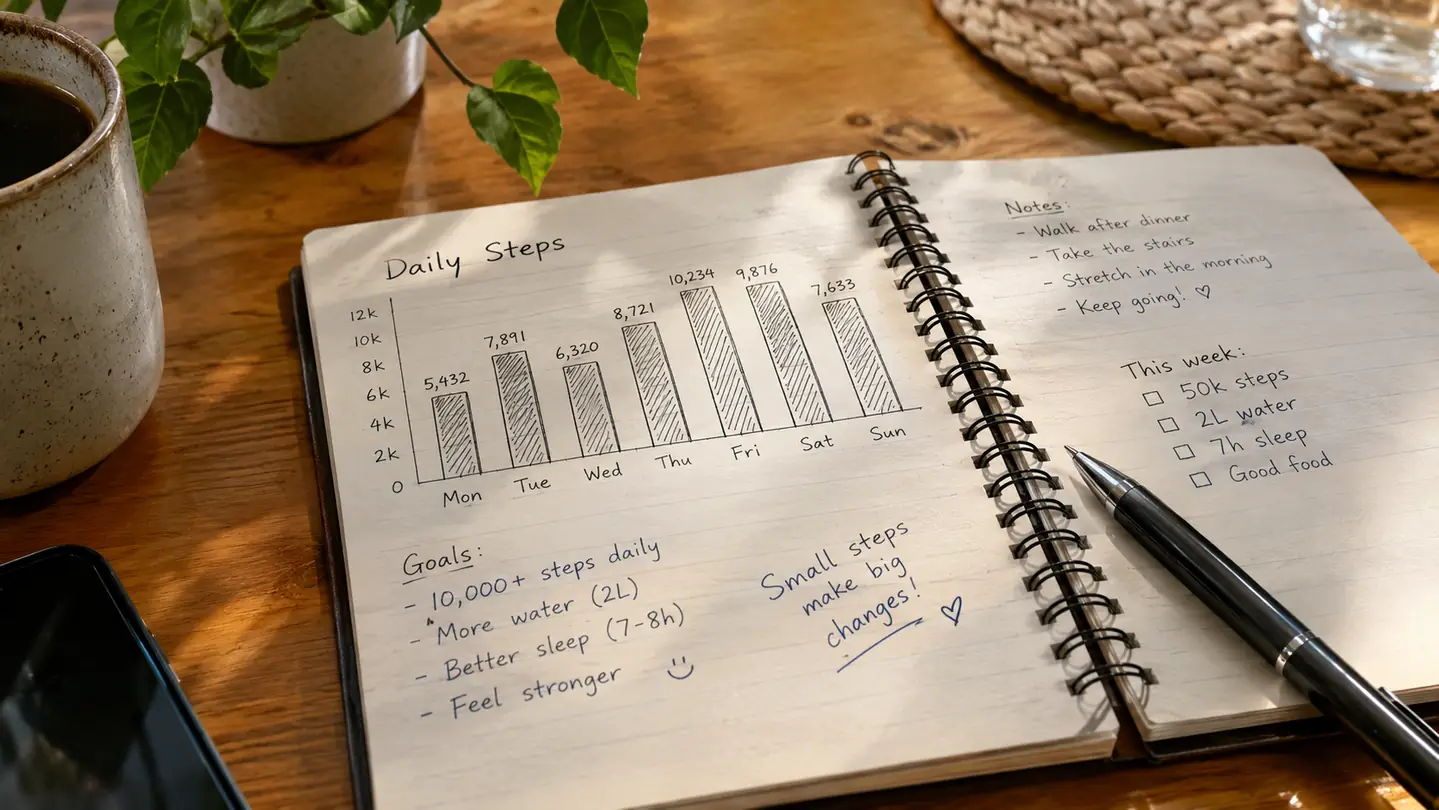
I kept a daily step log for eight weeks, and I learned that no single day tells the truth. Some days I hit 12,000. Some days I hit 6,000 because I had a long meeting at the library or a bad night of sleep. The days that matter are the ones in between. I started drawing a simple bar chart in my notebook, one bar per day, and I looked at the shape of the week instead of the height of any single bar. The trend went up, slowly and unevenly, and that is what I trusted.
I also gave myself permission to have an off day. This was the hardest part for me, because I am a person who likes to finish what I start. But I learned that one 4,000 step day does not undo a week of 9,000 step days. What undoes progress is the voice that says, well, I already missed today, so I might as well miss tomorrow. I wrote a note to myself on the inside cover of my notebook: one miss is a miss, two misses is a habit. It sounds simple, but it is the rule that kept me going through February.
After two months, my average went from 4,500 steps a day to just over 9,000. I do not hit 10,000 every day. I hit it about four days a week, and the other days I land in the 8,000s. That is a different person than the one who sat at her desk at 3 p.m. with aching knees and a guilty conscience. The walking pad did not do that by itself. The routine did. The pad just made the routine possible.
What Else Helps
A walking pad is a tool, not a plan. The plan is the routine, and the routine works better when you support it with the basics. I pair my walking with a simple lunch that has protein and vegetables, because I noticed that the days I ate a heavy sandwich, I did not want to walk afterward. I drink a full glass of water before each session, and I keep my walking shoes by the pad so I do not have to hunt for them. I also go to bed at a consistent time, because tired Linda skips steps and hungry Linda skips steps, but rested Linda walks.
If you are thinking about adding a supplement to support your routine, please talk to your doctor or pharmacist first, especially if you take any medications. I am not a doctor, and I do not give medical advice. What I can tell you is that I read the research summaries before I buy anything, I check the label, and I treat any supplement as a small support for a routine that is already built on food, walking, and sleep. No supplement replaces the walking. The walking is the medicine, and the pad is the delivery system.
The walking pad did not change my health by itself. The routine did. The pad just made the routine possible, and that is enough.
Start with ten minutes today
You do not need to hit 10,000 steps tomorrow. You need to hit ten minutes today, in the room where you already sit. The Ulfario Folding Walking Pad is the tool I used to build the habit, one short walk at a time.
Amazon Check Today's Price on Amazon →