
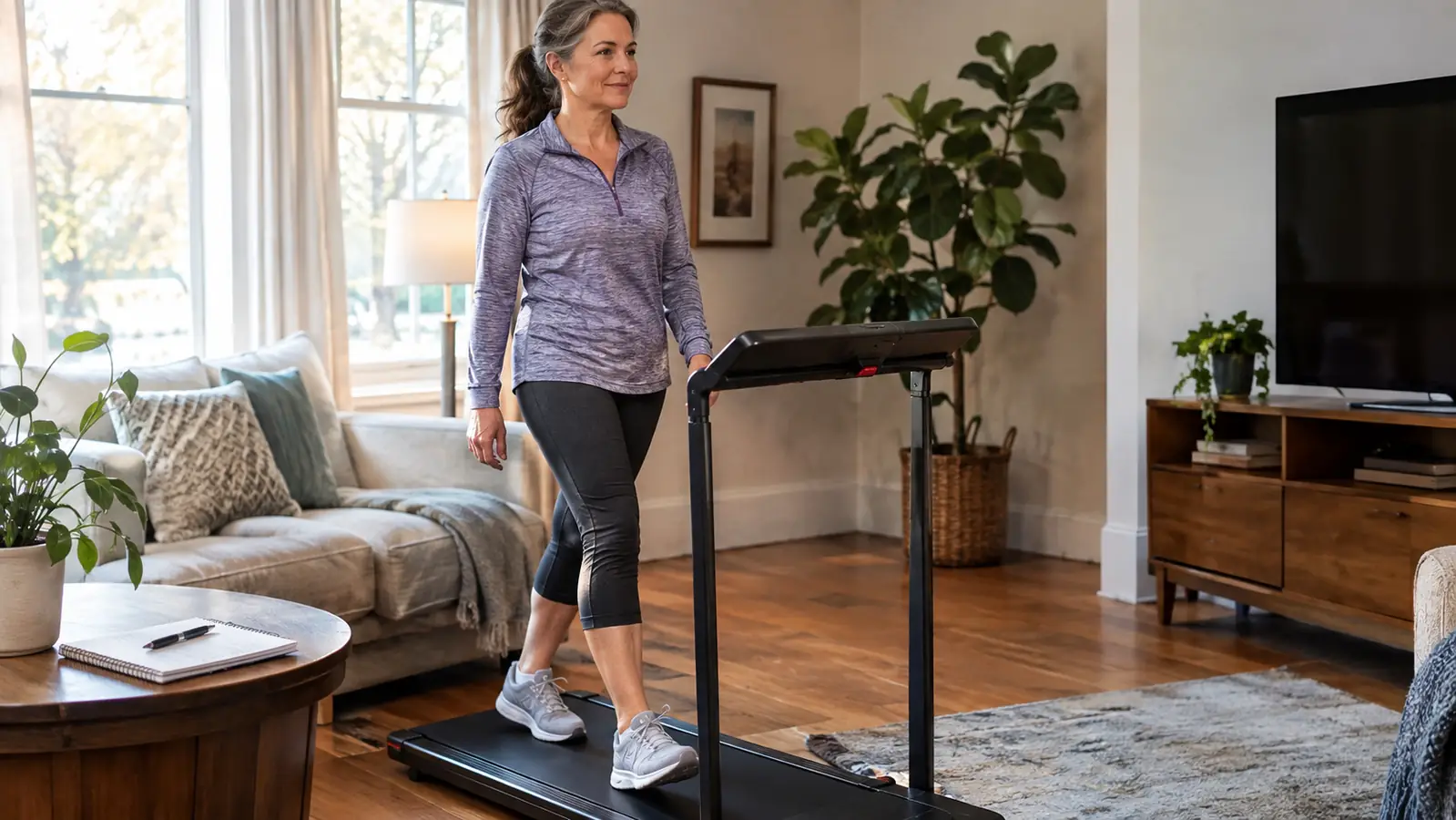
Three winters ago I stopped walking outside once the cold and the ice arrived, and I noticed the difference within two weeks. My knees, which had already been grumbling on the stairs, got louder. My neighbor and I had walked together every morning for years, but when the sidewalks froze over, we both gave up and told ourselves we would start again in spring. We did start again, and every November the same thing happened. I needed something that did not depend on the weather, and I needed it to live in my house without taking over the spare bedroom. I also needed it to be simple, because I have learned that if a piece of equipment takes effort to set up, I stop using it by February.
That is how the Ulfario folding walking pad ended up in my den. I read the reviews the way I read nutrition labels, slowly and with a notebook in my lap. The Ulfario name kept coming up because of the handle bar and the folding design, and because the brand had a solid rating across a few thousand reviews. After about a month of comparing, I ordered one. This is the review I wish I had found before I did. I have used this pad most mornings for months, tracked every session in my spiral notebook, and I can tell you exactly what holds up and what does not. None of it is hype. It is just what a retired librarian notices when she pays attention.
The Quick Verdict
For steady, everyday indoor walking, the Ulfario has earned its spot in my den. It folds flat, runs quietly enough for the news, and has held up for months. It is not a treadmill: the belt is narrow, there is no incline, and it will not satisfy a runner. Know what it is and it will not disappoint you.
Amazon Check Today's Price →A walking pad that folds flat against the wall
If you want indoor movement that does not depend on the weather, this is the pad I reach for most mornings. It supports a daily walking routine, and that consistency is what has actually moved my numbers over time.
Amazon Check Today's Price on Amazon →How I've Used It
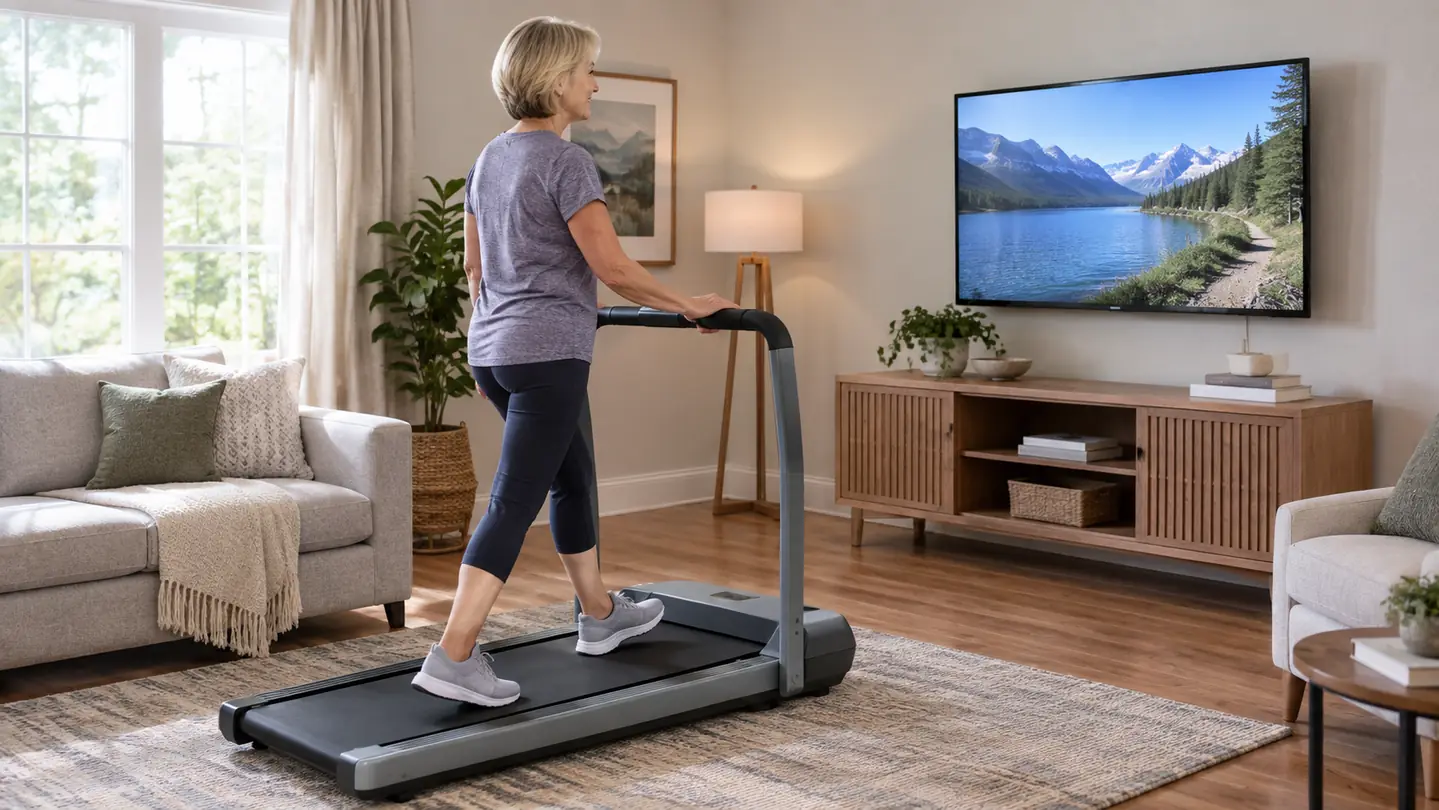
I ordered the Ulfario in late October, right before the first hard frost. It arrived in a box that was heavy but not unmanageable, and Dale carried it up from the front step for me. I set it up in the den, facing the window, with the television off to one side. My routine is the same most days: I walk for about thirty minutes in the morning while I catch up on the news, and if the day has been quiet I add another twenty minutes in the evening while I listen to a book. I have never been a fast walker, and this pad has never pushed me to be one. That is the point. It is built for a steady, natural pace, and that is what I give it.
I keep a spiral notebook for meals, steps, and how I feel, and the pad gives me two numbers to write down each day: the time and the steps. On a typical thirty minute session I log somewhere in the neighborhood of three thousand steps, which sounds modest until you add it up across a week. By the middle of my first winter, I had more than ninety logged sessions on the pad, and I could see the pattern in my notebook before I even felt it in my knees. Walking on the pad became the part of my day that I did not have to talk myself into, because it was always right there, already unfolded and waiting. That consistency, more than any single session, is what has carried me through the cold months.
The honest part is that I still walk outside with my neighbor whenever the weather allows. The pad is the backup that keeps me moving when it does not. I have used it through snow, freezing rain, and the kind of gray January mornings that make you want to stay in bed. It has been running for months with no maintenance beyond wiping down the belt and making sure the frame stays snug. I tightened the bolts once, around the three month mark, because I noticed a little give in the handle bar. That took me ten minutes with the wrench they included. I wrote the date in my notebook, and it has not needed attention since.
There was a stretch in February when I hit a plateau. My steps stayed the same week after week, and I started to wonder if the whole routine was worth it. What pulled me through was the notebook. I could look back and see that I had walked every single morning, even the ones I did not feel like walking. The pad did not make me faster or fitter overnight. It made me consistent, and consistency is the thing that actually showed up in how my knees felt on the stairs by spring. I want to be clear about that, because nobody should buy a walking pad expecting magic.
Setting It Up: What Arrived and What It Took
The box arrived with the walking pad, the handle bar, a small tool set, and a manual that I read twice because I did not trust myself the first time. Assembly took me about thirty minutes, most of it spent on the handle bar, which attaches to the front with four bolts. The instructions were clear enough that I did not need Dale's help, though he hovered anyway and handed me the wrench. The pad itself came mostly assembled, which is the part that surprised me. I unfolded it, plugged it in, turned it on, and it was ready to walk on. There was no confusing software to pair and no app to download, which suited me fine.
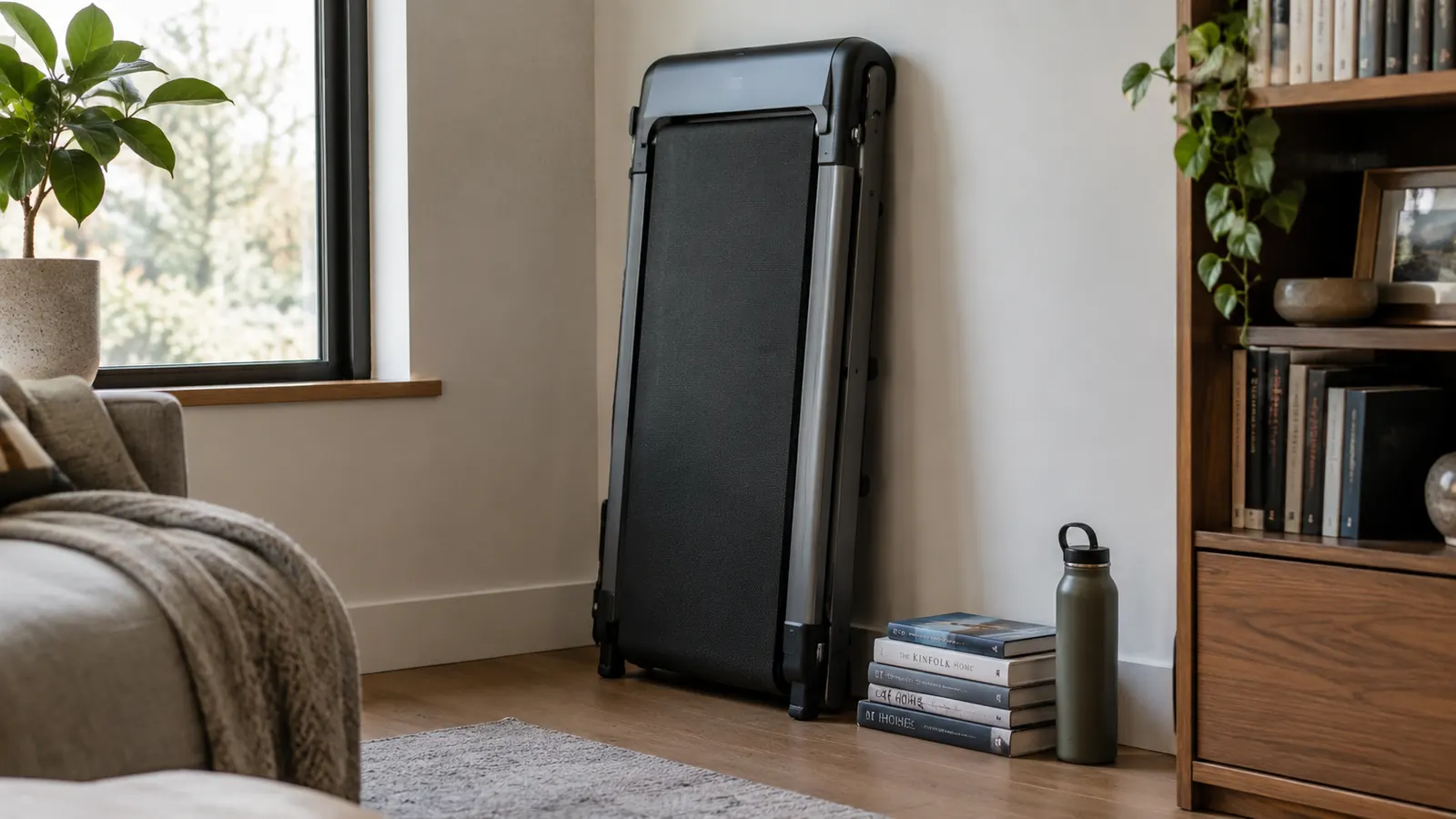
The one thing I would flag about setup is the weight. The pad is heavy enough that I would not want to carry it up and down stairs by myself, and I am glad it lives on the ground floor. It sits on a mat I bought to protect the floor, and I make sure the area in front of it is clear before I step on. Once it was in place, it took up very little room. Folded, it stands on end against the wall and takes up maybe a foot of floor space. That was the whole reason I picked it, and it has never once been a disappointment. I measured the folded depth the day it arrived and wrote it in my notebook: just under a foot.
The Folding Design That Sold Me
Folding was the feature that convinced me, and it is the feature that has held up best. When I am done walking, I press the release, fold the deck up, and stand the whole thing against the wall behind the door. It takes me ten seconds, and I do not have to be careful about it. The hinge has not loosened in months of daily use. I measured the footprint out of curiosity: folded, it sits maybe a foot deep against the wall, which means the den still works as a den when I am not walking. That matters more than you would think. I have watched other walking pads take over the corners of friends' homes, always unfolded, always in the way. I did not want that, and this design does not force it on me.
The tradeoff of a folding design is that the deck is a little lighter than a full treadmill, and you can feel it if you lean hard on the handle bar. I noticed a slight wobble in the bar when I first pushed on it, so I tightened the bolts. Now it is steady enough for me to rest a hand on while I walk, though I would not hang my full weight from it. I treat it as a balance aid, not a grab rail. That distinction matters, and it is part of why this is not the right machine for everyone. If you need a real rail to support you, you need a different machine. For me, a light hand on the bar is all I have ever needed.
What I did not expect is how much I would appreciate the wheels on the base. When I want to move the pad a few feet to vacuum behind it, I tip it onto the wheels and roll it. It is not a machine I would drag around the house, but moving it within the same room takes no effort at all. The folding design plus the wheels means the pad is never really in my way, which is the difference between a machine I use and a machine I avoid. I have had exercise equipment that ended up as a clothes rack. This has not, because it never makes demands on my floor space.
What Daily Use Actually Looks Like
Most mornings I turn on the television, step onto the belt, and set a speed that lets me walk at a natural pace. The Ulfario has a simple control on the handle bar, and the display shows my time, my steps, and a rough distance. I do not need anything fancier, and I like that it does not nag me with charts or streaks. I have learned to start slow and build up over the first minute, because stepping onto a moving belt cold is how you stumble. The belt is smooth, and I have never felt it slip or hesitate, even after a long session. I do most of my walking at a brisk but comfortable pace, and I can read a chapter of a novel on it if I am careful with the page.
What surprised me is how much it changed my evenings. Before the pad, I used to sit on the couch after dinner and snack out of boredom. Now I read my chapter standing on the belt, walking slowly, and the snacking mostly stopped on its own. I did not set out to change that habit. It just happened, because I had somewhere to put my restless energy. I track everything in my notebook, and the slow, steady walking is the constant that has supported everything else I have done with food and sleep. It is not a fix on its own. It is the dependable piece of routine that holds the rest together. I have told my neighbor that exact thing more than once.
On days when I am tired or sore, I still step on, but I set the speed lower and just walk for fifteen minutes. The pad does not care whether I am having a strong day or a weak one. It is always ready, and it never judges me. That sounds like a small thing, but it is the reason I have stuck with it. A machine that only works on my best days would not have gotten me through the winter. This one works on my worst days too, and that is worth more than any feature on the spec sheet. I have walked on it in sweatpants, in socks, and once in the middle of the night when I could not sleep.
What Nobody Mentions About Walking Pads
There are three things the listings do not tell you, and I want you to hear them from someone who has actually used this pad for months. First, a walking pad is not a treadmill. The belt is narrow, and you cannot run on it, and there is no incline. If you want to break a sweat running, this is the wrong machine. Second, it is not silent. It is quiet enough for the television and for a phone call, but you can hear it, a low hum that takes a few sessions to stop noticing. Third, the handle bar is for balance, not support. If you need something to hold your weight, you need a different machine with a real rail. None of those are flaws if you know what you are buying.
The noise is the thing I see most in one star reviews, and I understand it, but I also think it is a matter of expectation. I can hear my pad from the kitchen, but it is a steady, even hum, not a rattle. It has never been loud enough to interrupt a phone call, and I have watched entire movies with it running. What I would warn about instead is the narrow belt. You cannot turn around on it, and you have to be careful stepping on and off. I use the handle bar every single time I step on, and I would tell anyone to do the same. It is a small habit that keeps me safe.
The other thing nobody mentions is that the speed control is on the handle bar, which means you have to let go of the bar to adjust it. It is a small thing, but it makes you steadier on your feet if you set your speed and then leave it alone. I set mine at the start and rarely touch it again. I have also learned to stop the pad before I step off, which sounds obvious but is worth saying out loud. A walking pad will keep moving if you step off, and the belt will keep sliding under you. Stop it first, then step off. That has become my one rule.
What I Liked
- Folds flat against the wall in about ten seconds
- Quiet enough for the television or a phone call
- Held up through months of daily use with no repairs
- Simple controls and a clear display
- Wheels on the base make it easy to move within a room
- Genuinely supports a daily walking habit
Where It Falls Short
- Belt is narrow; it is walking only, not running
- No incline to work with
- Handle bar wobbles slightly if you lean on it
- Not silent, just quiet
- Heavy enough that I would not carry it up stairs alone
By the end of my first winter I had logged more than ninety sessions on this pad, and I could see the pattern in my notebook before I even felt it in my knees.
Who This Is For
This pad is for anyone who wants to walk more but keeps losing the battle to weather, time, or a small house. It is for people like me, in their fifties and sixties, whose knees and hips remind them that movement matters. It is for the person who wants to watch the news or listen to a book while getting steps in, and who does not want to drive to a gym to do it. If you walk every day outside and the only thing stopping you is the season, this solves that problem cleanly. I have recommended the Ulfario to my neighbor, and I would recommend it to anyone whose routine falls apart the moment the calendar turns to November.
It is also for the person who needs the machine to disappear when they are done. My den is small, and the fact that this folds against the wall is the reason I actually use it. A machine that has to be set up and taken down every time will get skipped. A machine that is always there, already unfolded and ready, does not get skipped. That is the real value of this pad, and it is worth more than any spec sheet. I have owned exercise equipment that became a clothes rack within a month. This pad has been in daily use since October, and I can tell you exactly why: it is never in my way.
I would add one more thing. If you are just starting to build a walking habit and you are not sure you will stick with it, a folding pad is a lower risk way to find out than a full treadmill. It takes less room, and it does not make you feel guilty when you are not using it, because it is not sitting in the middle of the room reminding you. Mine folds away so completely that I almost forget it is there, until I remember that I walked on it this morning and I already feel better for it.
Who Should Skip It
If you are a runner, skip it. The belt is too narrow and the speed tops out well below a running pace, and you will be frustrated within a week. If you need an incline to work different muscles, this has none, and you should look at a full treadmill. If you have balance problems or need to hold significant weight with your arms, the handle bar on this pad is not built for that. It is a balance aid, not a grab rail. You need a machine with a proper rail and more structure. I would not recommend this to anyone who is unsteady on their feet, no matter how good the price looks.
I would also say this: if you buy a walking pad expecting it to do the work for you, it will disappoint you. It is a tool that supports a routine. You still have to show up and walk. I checked with my doctor before I started exercising more at home, and I would tell anyone with an existing health condition or on medications to do the same before they buy. The pad is not a shortcut and it is not a treatment for anything. It is a dependable place to put your daily walk, and that is exactly what I needed it to be. If you want a machine that fixes you without any effort on your part, no walking pad will do that.
Months in, I still reach for it most mornings
If you want a folding walking pad that supports a daily walking habit without taking over your house, this is the one I have used every week since October. See the current price on Amazon and read more owner reviews before you decide.
Amazon Check Today's Price on Amazon →