
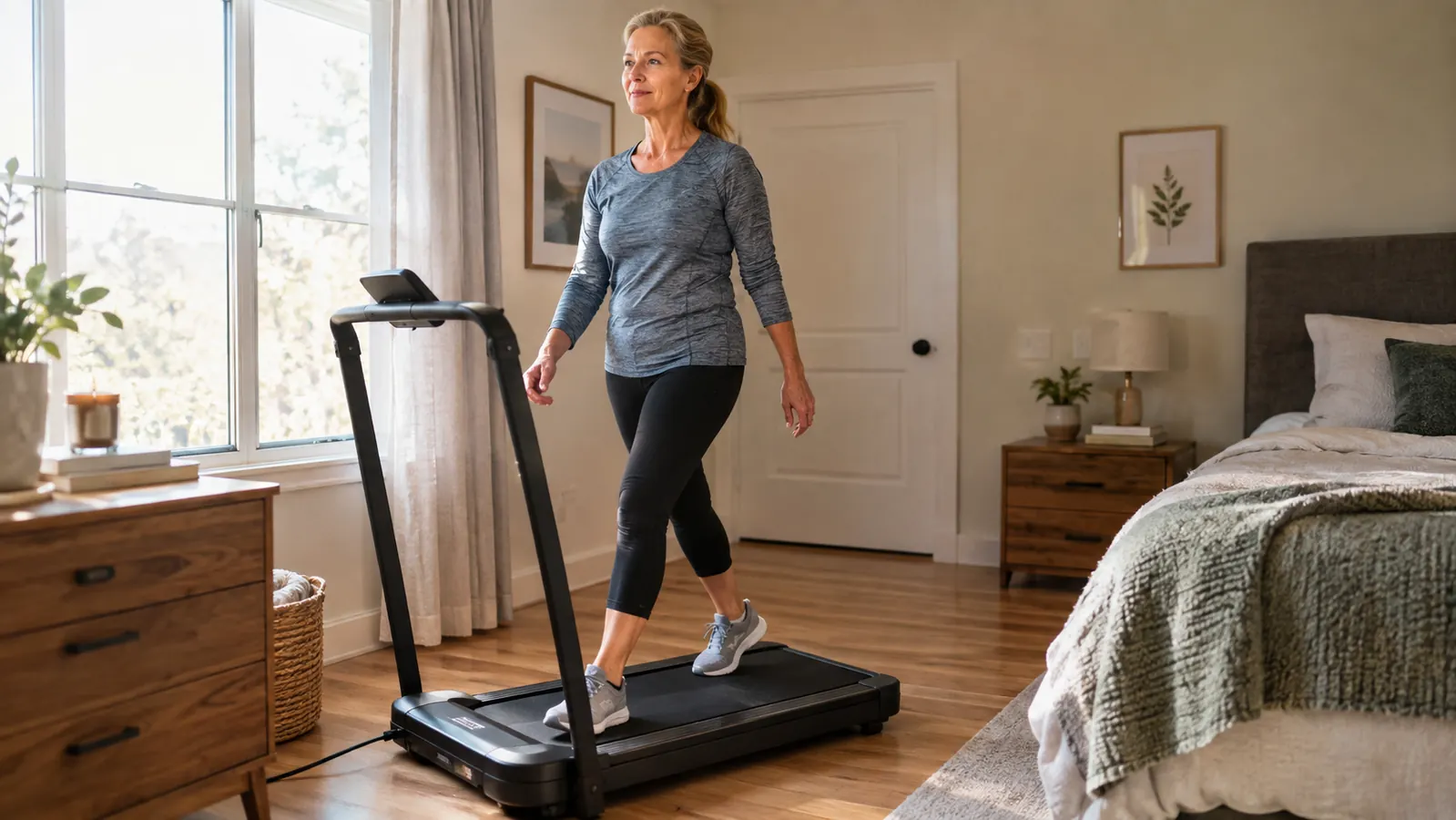
I will start with what nobody tells you about a folding walking pad, because that is the part I had to learn the hard way. It does not walk for you. I bought the Ulfario Folding Walking Pad in early September, mostly because my knees started complaining on the stairs and my neighbor kept inviting me for longer morning walks than I could handle. I had already tried a full treadmill at the gym near my house and hated it: the size, the noise, the way it took over the whole room. The idea with the pad was simpler. On days when the weather turned, or when my knees ached, I could still get my steps in without leaving the house. I kept my expectations low, and that turned out to be exactly the right approach. Three months later, I can tell you what works, what does not, and what the product page left out.
This is my honest review after roughly three months of nearly daily use, which means somewhere north of sixty sessions on the machine. I am a retired middle-school librarian in Springfield, Missouri, not a fitness professional and not a gadget reviewer. I track my meals, my steps and how I feel in a spiral notebook, the same way I used to track overdue books. I read the research summaries before I buy anything, and I read the manual for this pad before I even plugged it in. I wanted to know if this machine was a tool I would actually use or another piece of furniture collecting dust, and I think I can answer that honestly now.
The Quick Verdict
A solid, quiet-enough walking pad for steady home use, as long as you do not expect it to replace outdoor walking or to count your steps with precision.
Amazon Check Today's Price →The walking pad I kept using past week two
After three months of nearly daily use, the Ulfario Folding Walking Pad has earned its spot in my spare bedroom. It folds, it stores, and it gets me moving on days I would otherwise skip.
Amazon Check Today's Price on Amazon →How I've Used It
I set the pad up in the spare bedroom we use for my short home workouts. It took about fifteen minutes to unpack, and the folding frame meant I could lean it against the wall when I was done. For the first two weeks I used it for twenty minutes at a time, usually at a gentle pace while I listened to a podcast. By the third week I was up to thirty-five minutes most mornings, and I started keeping a folding chair nearby for the first five minutes until I found my balance. My husband Dale, who eats whatever he wants and never worries about steps, watched me the first morning and asked if I was going to fall off. I did not, but I did hold the handle bar a little tighter than I needed to for the first few days.
My routine is simple. I walk outside with my neighbor on clear mornings, and I use the pad on the days it rains, or when my knees tell me the pavement is not a good idea. The first big rain of the season came on a Thursday in late September, and that was the day I discovered how much I appreciated having the pad in the spare room. I keep a notebook by the pad and jot down the date, the time, the speed setting and how my knees feel afterward. That notebook is how I know the pad has not made anything worse, and it is also how I noticed the step count problem I will get to in a minute. On rainy weeks, the pad gets used four or five mornings out of seven. On clear weeks, it sits folded and I do not feel guilty about it.
I also learned early that the pad works best for me as a warm-up before my short home workouts, not as a replacement for them. Ten minutes on the pad gets my knees moving and my circulation going, and then I do the strength work in the same room. That combination has been the most useful part of my routine, and it is why the pad earns its spot rather than just taking up space. I would not want to be without it now, which is the highest praise I can give any piece of exercise equipment.
What Nobody Tells You Before You Buy
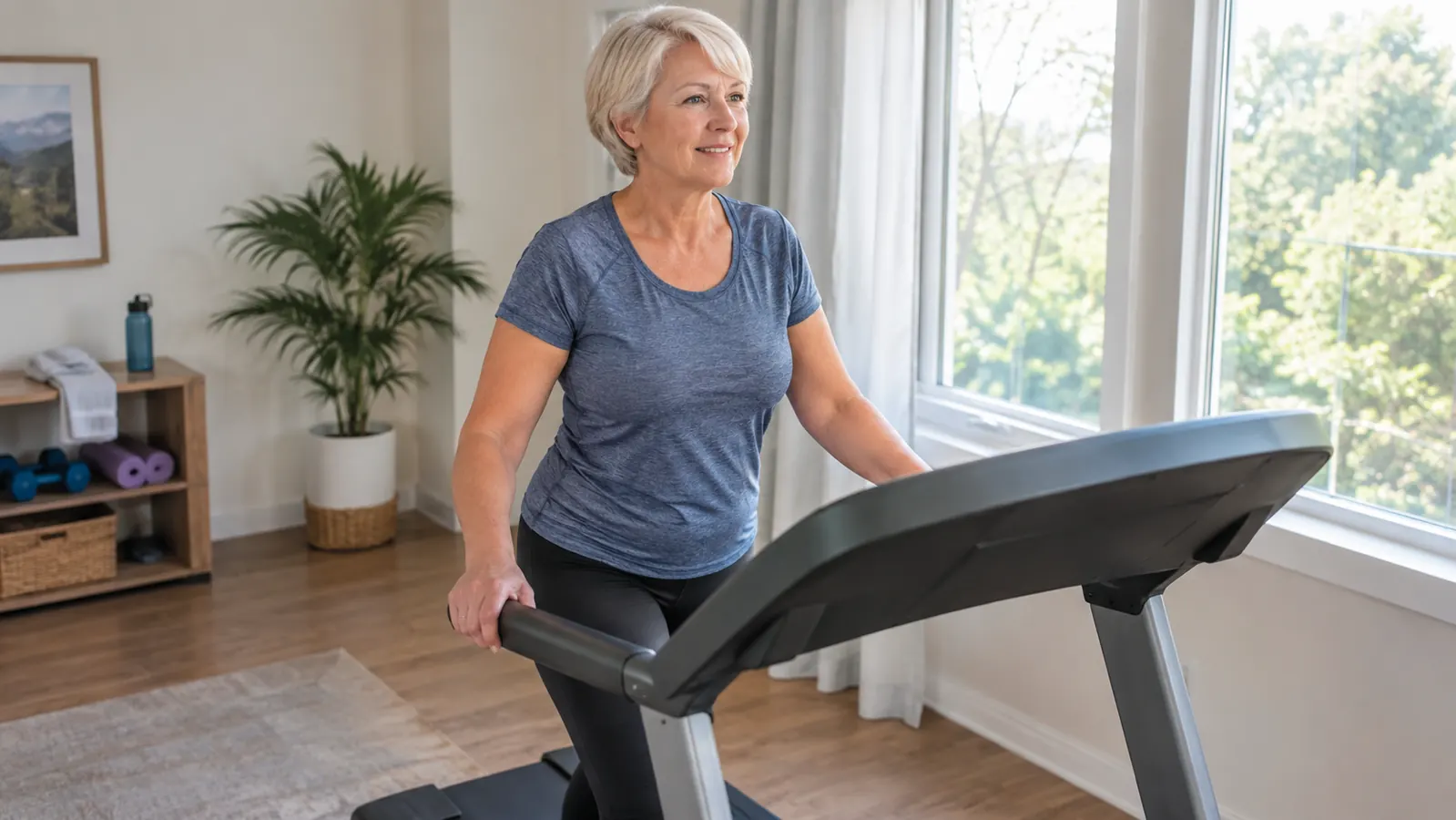
The first thing nobody tells you is that the word quiet on the box is doing a lot of work. The belt hums, and the motor has a low whir that is fine in a spare bedroom but would be loud in a small apartment with thin walls. Dale can hear it from the kitchen with the door open, and he is not trying to listen. It is not deafening, and it does not bother me with headphones on, but if you are picturing a silent machine, adjust that picture. I read the Ulfario manual's decibel claim and I believe it is roughly accurate, but a decibel number does not tell you how a sound carries through a house, or through an apartment floor.
The second thing is the surface. The deck is firm and a little grippy, which is good for safety, but it has almost no cushion. On days when my knees are already unhappy, I can feel every step in a way I do not feel on a sidewalk. I solved this by using the pad only on good knee days and saving the outdoor walk for the other days, but if you have serious joint pain, you should know that a firm deck will not coddle you. I tried a thicker pair of walking shoes on the pad, and that helped more than I expected, so I would plan for that rather than assuming the deck will be forgiving.
The third thing is assembly honesty. It is not fully assembled out of the box, but it is close. The folding deck clicks into place, the handle bar attaches with a few bolts, and I did it myself in about fifteen minutes with no help. That is the good news. The less good news is that the pad is heavier than it looks in photos, and I would not want to carry it up a flight of stairs alone. I keep it on the ground floor, and that is where it stays. If you live in a two-story house, plan for the pad to live on the floor where you will actually use it.
The Folding Mechanism and the Handle
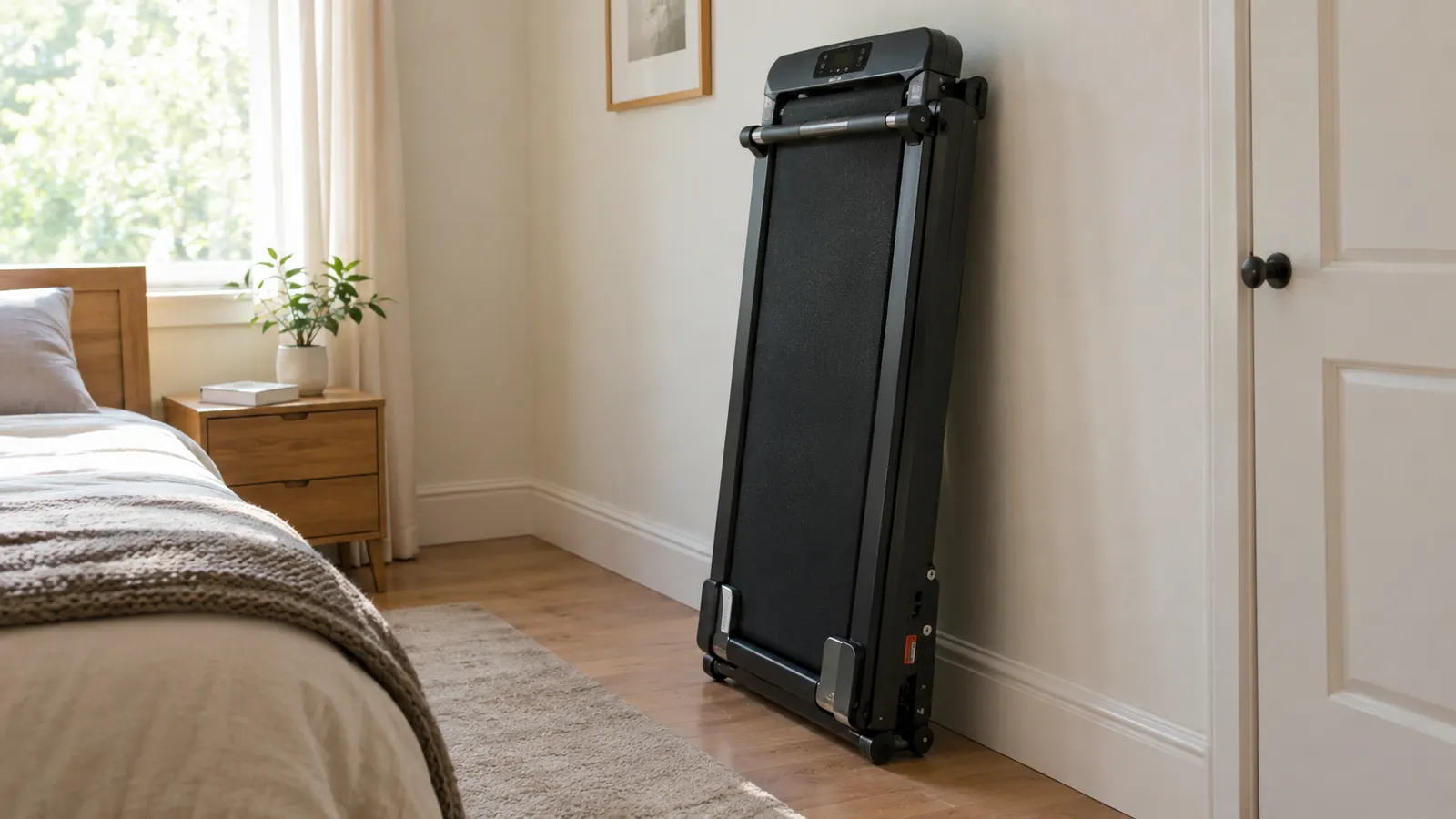
The folding part is genuinely good, and it is the reason I chose this model over a full treadmill. There is a latch near the base, the deck lifts, and the whole thing leans against the wall in about ten seconds. The handle bar folds down flat, which matters more than I expected, because it means the pad does not take up a corner the way a full treadmill would. In our spare bedroom, it sits behind the door, out of the way, and I do not trip over it. When it is folded, it measures about three feet long and a few inches thick, which sounds like a lot until you realize a full treadmill takes up half a room.
One thing the product photos do not show clearly is that the handle bar is a fixed height. If you are significantly taller than I am, or significantly shorter, you may find yourself reaching or hunching. I am five foot four and it is comfortable, but I would want to sit with the dimensions before buying if you are over six feet. The handle also has a small tray area where I rest my phone, which is a nice touch, though I would not trust it with anything fragile if you tend to bump the machine. I keep my water bottle on the floor beside the pad instead.
The Step Counter Problem
Now the part I wish someone had told me before I bought it. The pad's display counts steps, but it does not agree with my phone or my watch, and I have learned to treat its number as a relative measure, not a fact. On a day when my phone said 4,200 steps and the pad said 3,150, I trusted the phone. On another day the pad said more than my phone did. The discrepancy was never consistent in one direction, which tells me the pad is not miscalibrated in a simple way, it is just measuring something different from what my phone measures. My watch counts arm swings, my phone counts location changes, and the pad counts belt rotations, so of course they disagree.
Here is how I handle it. I use the pad's counter as a pacing tool during the walk, and I record my steps for the day in my notebook from my phone at the end of the day. The pad gets me moving, and my phone gives me the number I trust. If you are someone who needs an exact step count for training or for a challenge, this pad will frustrate you. If you just want to move more, it is fine. I also found that the display is easy to read from standing height, which matters more than you would think when you are mid-walk and do not want to stop.
What Surprised Me, Good and Bad
The good surprise: the belt has stayed centered. I read reviews of cheaper pads that drift to one side and need constant adjustment, and after three months I have not had to adjust mine once. That reliability is the main reason I would recommend the Ulfario to a friend. The bad surprise: the pad has a slight incline feel even at its lowest setting, which is fine for my knees but took me a week to get used to. It is not a real incline, just the way the deck and belt are built, and once I adjusted my stride it stopped bothering me. I noticed the incline feel most on the first day, and by the end of the first week I had stopped thinking about it entirely.
The other surprise was how much I use the speed presets. I thought I would fiddle with the controls every few minutes, but I settled on one speed for warm-up and one for the main walk, and I mostly leave it alone. The controls are simple enough that I did not need the manual after the first week. There is also a remote, which I thought I would lose immediately, but I keep it on the tray and it works from across the room. I was skeptical of a remote on a walking pad, but it turns out to be the one feature I use every single session.
What I Liked
- Folds flat and leans against a wall in about ten seconds
- Belt has stayed centered through three months of daily use
- Simple controls with useful speed presets and a remote
- Quiet enough for a spare bedroom with the door closed
- Sturdy build that has not wobbled at walking speeds
Where It Falls Short
- Step counter disagrees with my phone and watch, and not in a consistent direction
- Motor whir is noticeable in a quiet room
- Fixed handle height will not fit every body
- Firm deck offers almost no cushioning for achy knees
- Heavier than the photos suggest, so plan where it will live
The step counter was my biggest disappointment, but it was also my most useful lesson: the pad is a tool for moving, not a laboratory instrument.
Who This Is For
This pad is for someone like me: over fifty, trying to get more steps without punishing their knees, and willing to use it as one part of a routine rather than the whole routine. It is for people who have a spare wall to lean it against and who do not need a precise step count. It pairs well with the outdoor walks I still take most mornings, and it has kept me moving on the days when the weather or my knees said no. If you are the kind of person who already tracks your habits in a notebook, this pad will fit right into that system. It rewards consistency, and consistency is something you bring to it, not something it gives you.
It is also for people who live on one floor or can plan where the pad will live, because moving it up stairs is not something you will want to do often. And it is for anyone who wants a walking option that does not take over a room. Folding it away takes ten seconds, and that is the whole difference between using it and letting it collect dust. I have owned exercise equipment that became a clothes rack within a month, and this pad has not gone that way, mostly because it is so easy to put away.
Who Should Skip It
Skip it if you are over six feet tall and want a handle at the right height, or if you need a precise step count for training. Skip it if you live in a thin-walled apartment and need true silence, because the motor whir will carry. Skip it if you have serious knee problems and need a cushioned deck, because this deck is firm. And skip it if you are hoping a machine will do the work for you, because the pad only helps as much as you use it. I do not say that to be harsh, I say it because I have seen what happens when people buy equipment expecting motivation to come with it.
I would also say this: if you are considering the pad because you have given up on outdoor walking entirely, reconsider. The pad is a supplement, not a replacement. My best weeks are the ones where I walk outside with my neighbor on clear mornings and use the pad on the other days. The pad keeps me consistent, but it does not give me the fresh air or the company, and I would not want to give those up. Buy the pad to add to your routine, not to replace it.
If you want a walking pad that earns its spot in the spare room
Three months in, the Ulfario Folding Walking Pad is still the first thing I reach for on rainy mornings. It is not perfect, but it is honest, and it has kept me moving.
Amazon Check Today's Price on Amazon →